




What Is a Lift or Elevator?
The increase in the world’s population, urban development, the construction of skyscrapers, massive and towering high-rise buildings, and more have caused the elevator to become an essential device for us humans. An elevator or lift is a device used to move from one floor to another within a building. Although you may use stairs to reach your desired floor, an elevator is a very suitable and fast alternative to stairs. Cabin Plus Industrial Group is with you to provide the necessary information about elevators (lifts) and their types.
But What Is an Elevator?
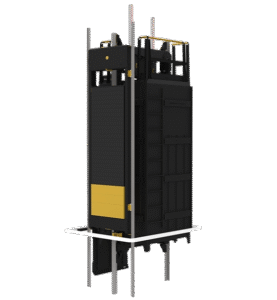
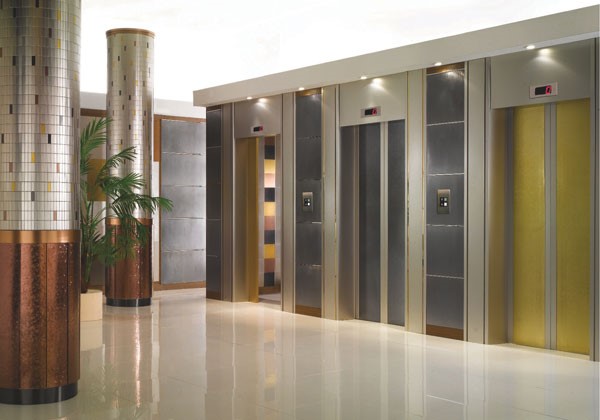
An elevator (lift) is a device used for the vertical transportation of people or goods to move between different floors of a building. Elevators consist of a closed vertical compartment called a cabin, in which people or goods are placed. Generally, this practical device is produced in various types and capacities depending on its application and usage. The design of this device can also be offered in attractive designs and colors according to customer preference.
 What Is an Elevator?
In fact, it can be said that an elevator is an electromechanical device, meaning it is made of mechanical and electronic components. This type of lift uses electric motors, traction cables, and counterweight systems to maintain balance and move the cabin. The driving force of the elevator (lift) used to transport loads between floors is provided in two ways: an electric motor or a hydraulic jack. It should be noted that some hydraulic systems use a jack to raise the cylindrical piston, which results in easier operation, reduced space requirements, and increased safety.
History of the Elevator (Lift)
The elevator is one of the earliest machines created by humans and is an evolved form of ancient lifting devices. According to historical documents, around 230 years before Christ, humans used pulleys to move their loads. In fact, people in ancient times did not know what an elevator was, but they were trying to find a way to transport humans. Today, with the use of mechanical equipment and the expansion of artificial intelligence technologies, this industry has achieved remarkable progress.
The elevator is an electromechanical device that initially consisted mostly of mechanical and electrical components, but with the expansion of the electronics field and its integration with artificial intelligence sciences, this practical device evolved and became essential. It should be noted that fields such as mechanics, architecture, industrial engineering, electricity, and electronics are involved in elevator design. After the remarkable advancement of elevators, the construction of large buildings and massive towers followed.

Types of Elevators
All elevators (lifts) are similar in terms of characteristics such as the cabin, vertical movement, and more. However, in terms of how the driving force is transferred to the cabin, they are divided into four categories: traction elevators, hydraulic elevators, magnetic elevators, and screw elevators.
What Is a Traction Elevator?
The traction elevator is one of the most common types of elevators and is suitable for high-rise buildings while also consuming low energy. This type of elevator is an electric elevator that moves the cabin using steel wire ropes. The driving force in this type of elevator is provided by an electric motor installed at the top of the elevator shaft or sometimes next to the pit. On the motor sheave, there are several steel cables called wire ropes, which are connected on one side to the elevator cabin and on the other side to the counterweights.

What Is a Hydraulic Elevator?
A hydraulic elevator is another type of elevator (lift) that moves the cabin using oil pressure inside an oil pump and a hydraulic jack. Unlike traction elevators, this type is mostly used for low-rise buildings. Recently, hydraulic elevators have gained popularity among home elevators and are also known as residential elevators. These elevators are not only designed for passenger transport but are also widely used for moving heavy loads. Examples include scissor car lifts, car elevators, and industrial lifting platforms.
Hydraulic elevators do not have a counterweight frame; therefore, the hydraulic jack system must move both the cabin and passengers, which requires a very powerful motor. These hydraulic lifts have a three-phase motor immersed in oil along with a special electric valve called a power unit, which provides the hydraulic pressure. The advantages of hydraulic elevators include:
-
- High power
-
- No need for a highly reinforced shaft ceiling
-
- Higher safety, especially during earthquakes
-
- Smooth movement and precise stopping
-
- Ability to move heavy loads
-
- No need for machine room space above the shaft
What Is a Magnetic Elevator?
Magnetic elevators are also categorized as electric elevators. This type of elevator uses magnetic energy to move the cabin. The structure of magnetic elevators is designed in such a way that they can operate without cables or motors. The advantages of this type of lift include very high safety and security during movement, while its main disadvantage is its higher cost compared to other elevators.
As mentioned, this elevator (lift) does not include components such as counterweights, steel cables, or a machine room. In fact, the rails and equipment attached to the shaft walls act as the stator of the motor, while the elevator cabin acts as the rotor. When electricity is supplied to the stator, a magnetic field is generated and transferred to the rotor, energizing the coils and moving the cabin.