

Elevator Cabin
The cabin design, in accordance with safety standards and modern technologies, brings a unique and enjoyable experience to passengers from the moment they enter the elevator until they reach their destination.



The cabin design, in accordance with safety standards and modern technologies, brings a unique and enjoyable experience to passengers from the moment they enter the elevator until they reach their destination.
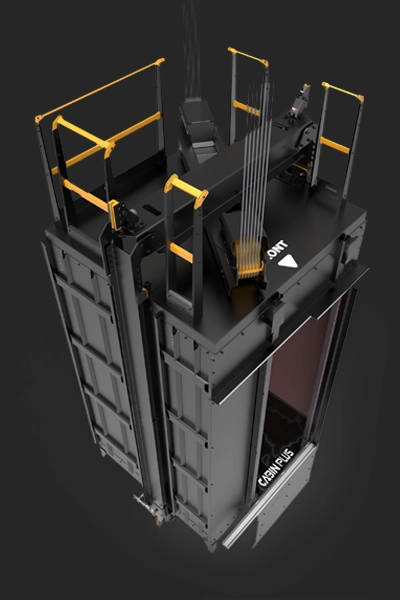
The elevator cabin, as an important and attractive part of the elevator, plays a vital role in the passenger transportation experience. This square chamber designed to transport passengers is not only a means of transporting people from one floor to another, but also a space that brings a sense of comfort and confidence to passengers with modern and creative designs.
Cabins fall into the following categories based on doors.



The cabins fall into the following categories based on capacities.

Personnel

Personnel

Personnel

Sleeper

Vehicle
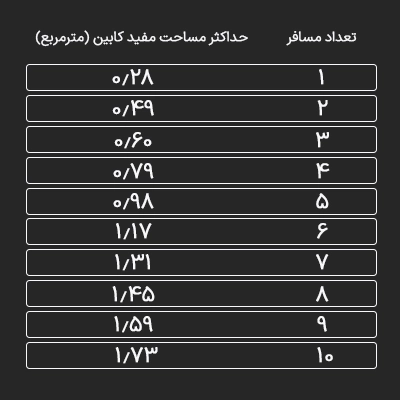
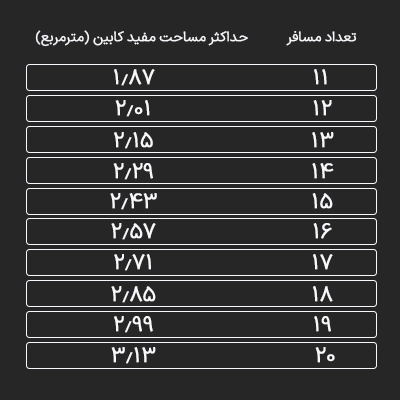
To calculate the capacity of the elevator cabin based on the number of people, you must consider the area required for each person. There are various standards that determine the sufficient area for each person in the elevator cabin. In general, the EN 81-20 standard for passenger elevators considers the useful (internal) area required for each person according to the table below.
We also use the following formulas to calculate the capacity of 20 people and above:
Length * Width = X X – 3.4 = Y N Y / 0.115 = Capacity = N + 20
To calculate the weight of the elevator cabin, we first determine the internal dimensions of the cabin; length, width, and height. Then we determine the type of material used to make the cabin, such as steel or aluminum, and determine the mass of that material. Now the volume of the cabin is calculated.
Cabinet weight (kg) = Internal parts and equipment (kg) + Total mass of materials used (kg/m3) × Cabin volume (m3)
To calculate the speed of the elevator cabin, first we add up the total height of the building from the first floor to the last floor. Then we measure the time it takes the cabin to travel this distance without stopping. Finally, we divide the total height by the time to obtain the average speed of the cabin. For example, if the total height of the building is 30 meters and the cabin travels this distance in 24 seconds, the average speed of the cabin will be 1.25 meters per second, so this cabin needs a motor that can provide this speed.
