


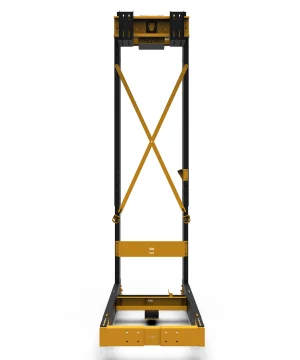
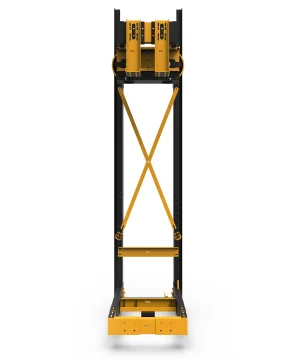
The elevator car sling (Car Sling) is a metal frame that serves as a support and force-transmitting component for the elevator cabin, especially in hydraulic and indirect traction systems.
The car sling is one of the key mechanical components in the elevator structure, responsible for supporting the cabin, transmitting force from the actuator to the cabin, and providing a base for installing safety equipment such as the parachute and guide shoes. This component is commonly used in hydraulic elevators with Side Direct and Indirect systems, but it is also used in some traction elevators.
Structure and Components of the Car Sling
The car sling consists of a sturdy metal frame that acts as the base for mounting the cabin. Its main components are:
- Metal Frame: Made of high-strength steel profiles, usually ST37 or ST52.
- Guide Shoes: For guiding vertical movement along the rails and reducing friction.
- Parachute: An emergency braking system that stops the cabin in case of excessive speed.
- Idler Pulley (in Indirect systems): For transmitting force from the jack to the car sling via steel cables.
In Side Direct systems, the car sling is mounted directly on the jack and does not include pulleys or a parachute, while in Indirect systems, these components are assembled on the car sling.
Mechanical Function
In hydraulic elevators, the hydraulic jack generates the driving force. This force is transmitted to the car sling either via a pulley or directly. The car sling then transfers this force to the cabin, enabling its vertical movement within the elevator shaft. During this process, the guide shoes are responsible for guiding and stabilizing the movement, while the parachute engages in emergency situations.
Advantages and Applications
- Reduced cabin manufacturing cost: Since the cabin is mounted on the car sling, a separate yoke is not required.
- Increased safety: With the installation of the parachute and guide shoes on the car sling, the cabin’s safety against free fall is ensured.
- Compatibility with various drive systems: Especially in hydraulic elevators, allowing easier installation and requiring fewer rails.
- Uniform force distribution: The car sling design ensures that forces applied from the jack or steel cables are evenly transmitted to the cabin.
Design and Installation Requirements
- Precise dimensions: Must be designed according to the cabin dimensions and elevator capacity.
- Industrial welding: Frame joints should be made with standard industrial welds to ensure sufficient strength.
- Level alignment: The car sling installation must be perfectly level to prevent abnormal wear of the guide shoes.
- Compliance with standards: Design and construction must comply with EN 81 standards and national building regulations.
Difference from Cabin Yoke
In traction elevators, the cabin is usually mounted on a yoke that includes upper and lower frames. In hydraulic elevators, the car sling replaces the yoke and all equipment is installed on it. This difference simplifies the mechanical structure and reduces costs.
Conclusion
The elevator car sling is a vital mechanical component that serves as a support, force-transmitting element, and base for safety equipment installation. Accurate design, proper construction, and correct installation of this component have a direct impact on the performance, safety, and durability of the elevator system.
